
Skip to content
TESS — The Eye Super Specialities

Clinical speciality

Corneal Disorders

The cornea is the eye's clear, protective outer layer, shielding it from dirt and germs while helping focus light onto the retina. When infection, injury or disease damages the cornea, vision can be affected. TESS — The Eye Super Specialities, Ghatkopar East, Mumbai evaluates and treats the full range of corneal disorders.

+91-8879117262

Quick answer

The cornea is the eye's clear, dome-shaped front surface. Corneal disease covers a wide range of conditions — infections, injuries, dystrophies, autoimmune and allergic disorders, and thinning conditions such as keratoconus — that can cloud or distort this surface and affect vision. Diagnosis relies on corneal imaging and examination, and treatment depends entirely on the specific condition identified.

What are corneal disorders?

The cornea is the transparent, dome-shaped tissue at the front of the eye that protects it from dirt and germs and helps focus light onto the retina. Corneal disease refers to any condition that damages its clarity, shape or surface.
Symptoms and signs

  • Eye redness, pain or a foreign-body sensation
  • Cloudy, hazy or reduced vision
  • Excessive tearing or discharge
  • Light sensitivity
  • Visible white or grey patch on the cornea

Causes and risk factors

  • Bacterial, fungal or viral infection
  • Mechanical, chemical or toxin-related injury
  • Inherited corneal dystrophies or degenerative changes
  • Autoimmune disorders such as Wegener's disease, lupus or rheumatoid arthritis
  • Nutritional deficiencies and allergies
  • Ectasia — progressive thinning of the cornea, as in keratoconus
  • Stevens-Johnson syndrome — a rare, severe inflammatory reaction

When should I see an eye specialist?

Book a routine appointment if

  • Gradually blurring or distorted vision
  • A known corneal condition due for monitoring

Seek prompt medical attention if

  • Sudden eye pain, redness or light sensitivity
  • Chemical splash or foreign body in the eye
  • A visible white or grey patch on the cornea

Corneal infections and injuries can progress quickly, so new symptoms should be assessed promptly rather than waiting.

How is it diagnosed?

Corneal conditions are evaluated with dedicated corneal imaging alongside a standard eye examination.

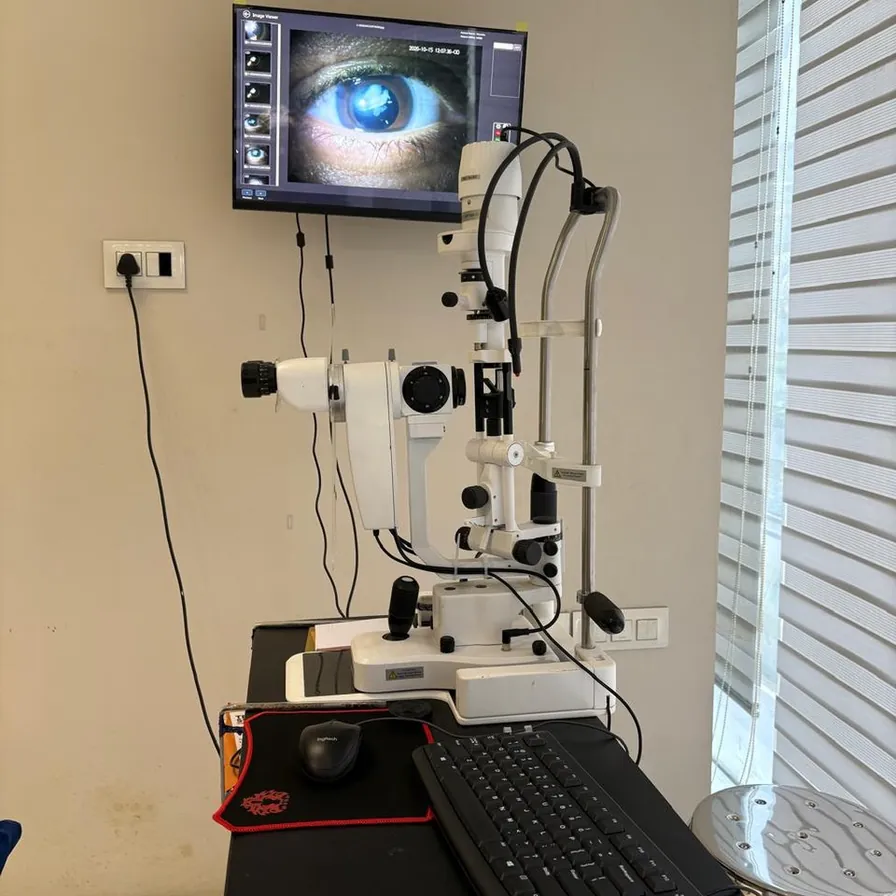
Digital slit lamp with a wall-mounted monitor showing a captured image of the eye, used to examine the cornea at TESS
Slit lamp examination
To examine the cornea's surface, layers and any scarring, infection or foreign material in detail
Pentacam / Oculyzer
To map the front and back corneal surface, measure thickness, and detect and monitor conditions such as keratoconus
OCT
To obtain cross-sectional imaging of the cornea to assess thickness and layer-by-layer changes

Not every patient needs every test. The examining ophthalmologist decides which investigations are appropriate.

What treatment options are available?

Treatment is specific to the underlying corneal condition and is decided after examination and imaging.

Infections are treated with targeted anti-infective eye drops depending on the organism identified

Autoimmune or allergic corneal disease is managed alongside control of the underlying condition

Irregular corneas — including keratoconus — may be managed with specialised contact lenses, including scleral lenses, where regular glasses or lenses are not sufficient

Who may benefit from this treatment?

Suitability for a specific corneal treatment depends on the diagnosis, severity and corneal shape identified on examination.

  • A confirmed corneal diagnosis on slit lamp and imaging
  • General eye health assessed to rule out other contributing conditions

Suitability can only be confirmed after a detailed examination at TESS. This page does not assess or diagnose individual patients.

What should I expect?

Recovery and follow-up

Recovery depends on the underlying condition and treatment chosen

Regular follow-up is generally needed to monitor healing and corneal clarity

Types of corneal disease

  • Infections — bacterial, fungal and viral
  • Trauma — mechanical, chemical and toxin-related injuries
  • Dystrophies and degenerative corneal disorders
  • Autoimmune disorders — including Wegener's disease, lupus and rheumatoid-arthritis-related corneal involvement
  • Nutritional deficiencies
  • Allergies
  • Growths — benign and malignant growths on the surface of the eye
  • Ectasia — thinning of the cornea
  • Stevens-Johnson syndrome — a rare inflammatory reaction

Questions to ask your ophthalmologist

  • What is the exact corneal condition I have?
  • Is it likely to progress, and how will it be monitored?
  • What treatment options are appropriate for my case?
  • Will I need specialised contact lenses?
  • Are there activities or exposures I should avoid while healing?

Book an appointment

Request a consultation at TESS, 201, 301, Punit Plaza, next to Rajawadi Post Office, Ghatkopar East, Mumbai, Maharashtra 400077. Call +91-8879117262 or send a request and the clinic will confirm your slot.

What to bring

  • Details of when symptoms started and any recent injury or exposure
  • Your current glasses or contact lens prescription
  • A list of any known allergies or autoimmune conditions